Portugal Government Scholarship 2027: Eligibility, Benefits, Application Process
Portugal Government Scholarship 2027 helps eligible students study in Portugal through state-backed financial support, higher education grants and doctoral funding opportunities.
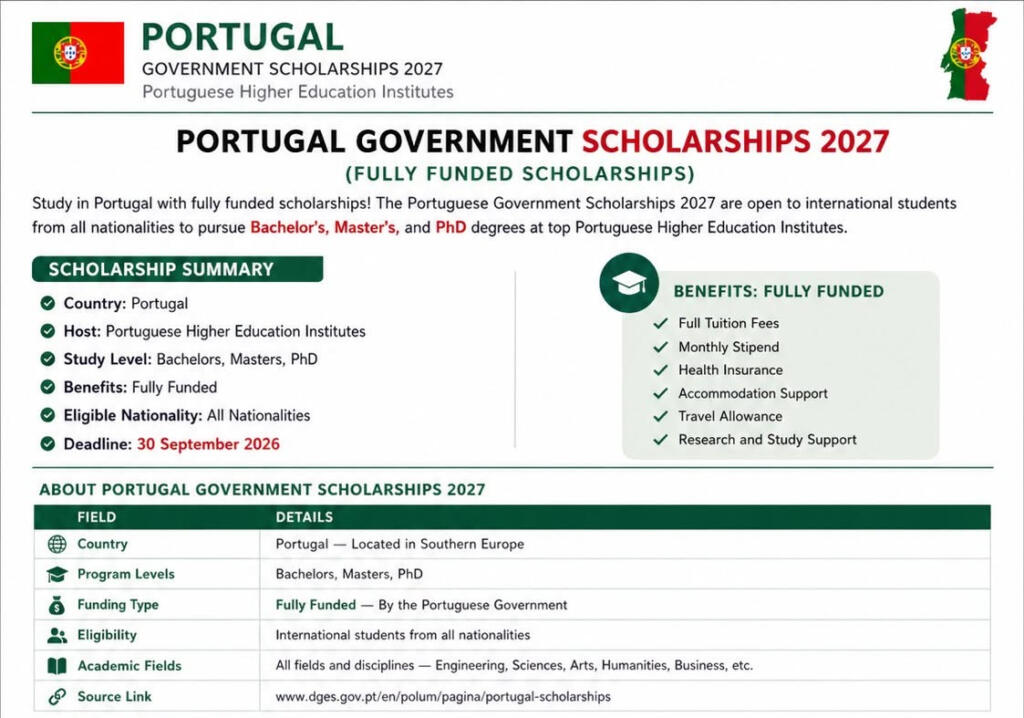
The Portugal Government Scholarship 2027 is a popular search term among international students who want to study in Portugal with financial support.
However, students should understand one important thing before applying. Portugal does not have just one single scholarship called “Portugal Government Scholarship 2027” for every international student. The term is often used to describe different government-backed funding options in Portugal, especially the DGES higher education grants, FCT PhD studentships, and other public scholarship programmes linked to Portuguese institutions.
For Nigerian students and other international applicants, this matters because the rules are not the same for every scholarship. Some grants are for students already enrolled in Portuguese higher education institutions. Some are for doctoral research. Some may be limited by residence status, nationality, programme type or financial need.
This guide explains the main Portugal government scholarship routes for 2027, who can apply, what the scholarship may cover, likely deadlines, required documents and how to avoid common mistakes.
Table of Contents
- What Is the Portugal Government Scholarship 2027?
- Main Portugal Government Scholarship Options for 2027
- 1. DGES Higher Education Grant
- 2. FCT PhD Studentships
- 3. Portuguese Language and Culture Scholarships
- Who Can Apply for the Portugal Government Scholarship 2027?
- Benefits of the Portugal Government Scholarship
- Portugal Government Scholarship 2027 Deadline
- Eligible Study Levels
- Admission for International Students in Portugal
- Required Documents
- How to Apply for Portugal Government Scholarship 2027
- Step 1: Choose Your Study Level
- Step 2: Find a Portuguese Institution
- Step 3: Confirm Your Eligibility
- Step 4: Apply for Admission
- Step 5: Contact the School’s Social Services Office
- Step 6: Submit the Scholarship Application
- Step 7: Track Your Application
- Important Warning for Nigerian Applicants
- Best Universities to Check in Portugal
- Common Mistakes to Avoid
- Conclusion
- FAQs About Portugal Government Scholarship 2027
- What is the Portugal Government Scholarship 2027?
- Is the Portugal Government Scholarship fully funded?
- Can Nigerians apply for Portugal Government Scholarship 2027?
- What is the deadline for Portugal Government Scholarship 2027?
- Does the DGES grant cover PhD programmes?
- How do international students apply to Portuguese universities?
- What documents are needed?
- Can I apply without admission?
- Where can I apply for FCT PhD studentships?
- Is Portugal good for Nigerian students?
What Is the Portugal Government Scholarship 2027?
The Portugal Government Scholarship 2027 refers to financial support opportunities funded or supported by the Portuguese government for students in higher education.
The most commonly mentioned option is the DGES grant, managed through Portugal’s higher education support system. DGES describes the grant as an annual non-repayable monetary benefit awarded by the State to help students cover expenses related to attending a course or compulsory internship, especially where the student’s household does not have enough financial resources.
This means it is not a loan. If awarded, the student does not need to pay it back.
There are also government-backed doctoral funding opportunities through FCT, the Foundation for Science and Technology. FCT doctoral studentships support research activities leading to the award of a PhD degree.
So, when students search for Portugal Government Scholarship 2027, they should first identify the exact scholarship route that fits their study level.
Main Portugal Government Scholarship Options for 2027
There are three main options students should know about.
1. DGES Higher Education Grant
The DGES grant is one of the main state-supported student grants in Portugal.
It is designed to support eligible students enrolled in Portuguese higher education institutions. According to DGES, grants may be awarded for courses such as Professional Higher Technical Courses, Licenciatura courses, Integrated Master’s courses and Master’s courses.
For students interested in undergraduate or master’s study in Portugal, this is usually the first government grant they come across.
However, there is a major warning for international students. DGES states that students who enter higher education under the international student regime do not have access to direct social support and are therefore not eligible for the grant, except in emergency humanitarian situations.
This is why Nigerian applicants must be careful. If you are applying as a regular international student from outside the EU, you may not automatically qualify for the DGES grant.
2. FCT PhD Studentships
For students who want to study for a PhD in Portugal, the FCT doctoral studentship is another important government-backed funding route.
FCT says doctoral studentships are for candidates who are enrolled in a doctoral programme or who meet the requirements to enrol in one. The funding supports research activities leading to a doctoral degree.
For the 2026 call, FCT opened applications from March 2 to March 31, 2026. FCT also noted that the usual timing of the call has generally remained around March or, sometimes, March to April.
This means students targeting 2027 should monitor the FCT website early, especially from the first quarter of the year.
3. Portuguese Language and Culture Scholarships
Some students may also find scholarships connected to Portuguese language, culture or cooperation programmes. These are often managed through Portuguese public institutions such as Camões, I.P.
These scholarships may not be the same as full degree scholarships. Some may support short courses, language study, research, cultural exchange or specific cooperation programmes.
Students should read each call carefully before applying because the eligibility, benefits and duration can be very different from a full undergraduate, master’s or PhD scholarship.
Who Can Apply for the Portugal Government Scholarship 2027?
Eligibility depends on the scholarship route.
For the DGES grant, Portuguese citizens are not the only people who may qualify. DGES lists other possible eligible groups, including EU nationals with permanent residence rights in Portugal, some third-country nationals with permanent residence or long-term resident status, stateless persons and beneficiaries of political refugee status.
But students entering Portugal under the international student regime are generally not eligible for direct social support, except in humanitarian emergency cases.
For FCT PhD studentships, the 2026 regular call allowed Portuguese citizens, EU citizens, third-country nationals, stateless citizens and beneficiaries of political refugee status to apply. Applicants also had to meet the doctoral admission conditions and other call requirements.
For Nigerian applicants, the best approach is to first decide your study level:
If you want undergraduate or master’s admission, check the university’s international student rules and ask the school if any institutional scholarship is available.
If you want PhD funding, check FCT calls and prepare your research proposal, supervisor contact and academic documents early.
Benefits of the Portugal Government Scholarship
The benefits depend on the scholarship type.
For DGES grants, the support is meant to help students meet education-related costs while attending a course or compulsory internship. The grant is normally awarded for a full school year, except in specific cases.
For FCT PhD studentships, selected applicants may receive a monthly allowance and other support such as tuition fees, support for additional training activities, presentation of work at scientific meetings, personal accident insurance and, where applicable, travel and relocation costs.
Possible benefits may include:
- Tuition support
- Monthly allowance
- Accommodation-related support in some cases
- Research support for PhD students
- Travel or relocation support where applicable
- Insurance support for doctoral students
- Support for compulsory internships in eligible cases
Students should not assume that every Portugal government scholarship is fully funded. Always check the official call notice before applying.
Portugal Government Scholarship 2027 Deadline
The deadline depends on the funding type.
For DGES higher education grants, the general application period is listed as between June 25 and September 30. DGES also allows applications within 20 working days after enrolment if enrolment happens after September 30. Applications may still be submitted between October 1 and May 31, but the grant amount may be proportional based on the submission date.
For FCT PhD studentships, the 2026 regular call opened on March 2, 2026 and closed on March 31, 2026. Since FCT says the usual timing is generally around March or March to April, students interested in the 2027 call should start checking from early 2027.
A safe timeline for 2027 applicants would be:
- January to March 2027: monitor FCT PhD calls.
- June to September 2027: monitor DGES higher education grant applications.
- Before applying: confirm admission rules with your chosen university or polytechnic.
Eligible Study Levels
Portugal government-backed funding can apply to different levels, but not every scholarship covers every programme.
DGES grants may support:
- Professional Higher Technical Courses
- Licenciatura programmes
- Integrated Master’s programmes
- Master’s programmes
- Some compulsory professional internships after graduation
For PhD programmes, DGES directs students to FCT.
This means a student applying for a bachelor’s or master’s programme may need to check DGES and the school’s social services office, while a PhD applicant should check FCT.
Admission for International Students in Portugal
Scholarship and admission are not always the same thing.
DGES states that international students apply directly to the university or polytechnic institution they want to enrol in. Each institution has its own application procedures, admission requirements, deadlines and documents.
This is very important for Nigerian students. You may need to first secure admission or enrolment before some funding options become relevant.
Portugal’s higher education system includes university and polytechnic education. Universities and polytechnics can award licenciatura degrees, while master’s degrees may also be awarded by both systems. Doctoral degrees are awarded by universities.
Required Documents
The required documents depend on the scholarship and the institution.
For undergraduate and master’s admission, international students may need:
- International passport
- Secondary school certificate or bachelor’s degree certificate
- Academic transcript
- Proof of English or Portuguese language ability, depending on the course
- Motivation letter
- Curriculum vitae
- Recommendation letters, where required
- Proof of application or admission
- Financial documents
- Residence documents, where applicable
For FCT PhD studentships, applicants usually need stronger research documents, including:
- Academic certificates
- Academic transcripts
- Curriculum vitae
- Research work plan
- Supervisor or host institution details
- Proof of enrolment or eligibility for PhD admission
- Degree recognition documents, where required
- Other documents listed in the official FCT call
FCT applications are submitted online through the myFCT platform, and documents submitted by other means are not accepted for the regular call.
How to Apply for Portugal Government Scholarship 2027
The application process depends on the scholarship route.
Step 1: Choose Your Study Level
First, decide whether you are applying for undergraduate, master’s or PhD study.
This matters because DGES and FCT do not serve exactly the same group of students.
Step 2: Find a Portuguese Institution
Search for recognised universities and polytechnics in Portugal. Check the course page, tuition fee, language of instruction and admission deadline.
Do not depend only on scholarship blogs. Always check the official university or polytechnic website.
Step 3: Confirm Your Eligibility
Before applying, confirm whether your nationality, residence status, study level and programme type match the scholarship rules.
For example, a non-EU student applying under the international student regime may not qualify for the DGES social grant.
Step 4: Apply for Admission
International students usually apply directly to the Portuguese institution they want to attend. Since each school has its own process, check the school portal carefully.
Step 5: Contact the School’s Social Services Office
For DGES grants, DGES advises students to contact the Social Services or Social Office of the higher education institution they attend.
This office can explain whether you are eligible and how to access the application system.
Step 6: Submit the Scholarship Application
For DGES grants, applications are submitted through the online scholarship system. For FCT PhD studentships, applications are submitted through myFCT.
Make sure all documents are uploaded before the deadline.
Step 7: Track Your Application
After submission, regularly check your application dashboard, email and school portal. You may be asked for additional documents or clarification.
Application Portal: https://www.gov.pt/servicos/candidatar-se-a-uma-bolsa-de-estudo-para-o-ensino-superior
Important Warning for Nigerian Applicants
Many websites describe the Portugal Government Scholarship as “fully funded for all international students”. That can be misleading.
The DGES grant is a real government-supported grant, but international students entering under the international student regime generally do not have access to direct social support.
This does not mean Nigerians cannot study in Portugal or cannot get funding. It means you must check the exact scholarship type.
For Nigerians, the most realistic options may include:
- University-specific scholarships
- FCT PhD studentships for eligible doctoral applicants
- Erasmus+ opportunities
- Research grants
- Country-specific cooperation scholarships
- Fee reductions or merit awards from Portuguese institutions
Before paying any agent, confirm the opportunity from an official university, DGES, FCT or Portuguese government source.
Best Universities to Check in Portugal
Students interested in studying in Portugal can check universities and polytechnics based on their course of interest.
Popular institutions include:
- University of Porto
- University of Lisbon
- NOVA University Lisbon
- University of Coimbra
- University of Aveiro
- University of Minho
- University of Algarve
- University of Beira Interior
- Polytechnic Institute of Porto
- Polytechnic Institute of Lisbon
Each school has different admission rules, tuition fees and scholarship options. Since DGES says international applicants apply directly to the institution, students should visit the official school website before making decisions.
Common Mistakes to Avoid
Many applicants make mistakes because they rush after seeing the words “Portugal Government Scholarship”.
Avoid these mistakes:
- Assuming every international student is eligible
- Applying without first checking the official source
- Confusing admission with scholarship approval
- Ignoring residence status rules
- Missing the DGES or FCT deadline
- Choosing a course without checking tuition fees
- Paying agents without verifying the scholarship
- Waiting until the final week to prepare documents
- Applying for PhD funding without a strong research plan
- Ignoring language requirements
A good application starts with careful research.
Conclusion
The Portugal Government Scholarship 2027 can be a useful opportunity, but students must understand what the term really means.
For undergraduate and master’s students, the main government-backed support is usually connected to DGES higher education grants. However, international students entering under the international student regime are generally not eligible for direct social support, except in special humanitarian cases.
For PhD applicants, FCT doctoral studentships are a stronger funding route. These support research leading to a doctoral degree and may include monthly allowance, tuition fees and other research-related support.
If you are applying from Nigeria, do not depend only on social media posts or scholarship blogs. Check the official DGES website, FCT website and your chosen Portuguese university portal before applying.
FAQs About Portugal Government Scholarship 2027
What is the Portugal Government Scholarship 2027?
It is a general term used for government-backed financial support in Portugal, including DGES higher education grants and FCT PhD studentships.
Is the Portugal Government Scholarship fully funded?
Not always. Some support may cover living or study costs, while FCT PhD studentships may include monthly allowance, tuition fees and other research support. Always check the official call.
Can Nigerians apply for Portugal Government Scholarship 2027?
Nigerians can apply for eligible funding routes, but they must check the exact scholarship rules. Students entering under the international student regime may not qualify for DGES direct social support.
What is the deadline for Portugal Government Scholarship 2027?
For DGES grants, the general application period is usually between June 25 and September 30. For FCT PhD studentships, calls usually open around March or March to April, but students should confirm the 2027 dates from FCT.
Does the DGES grant cover PhD programmes?
No. DGES directs students interested in doctoral grants to FCT.
How do international students apply to Portuguese universities?
International students apply directly to the university or polytechnic institution they want to attend. Each school has its own application rules and deadline.
What documents are needed?
Common documents include passport, academic certificates, transcripts, CV, motivation letter, recommendation letters and proof of admission. PhD applicants may also need a research proposal and host institution details.
Can I apply without admission?
For many funding options, you need to apply for admission or be enrolled before the scholarship becomes relevant. Check the rules of the exact scholarship.
Where can I apply for FCT PhD studentships?
FCT PhD studentship applications are submitted through the myFCT platform during the official application period.
Is Portugal good for Nigerian students?
Portugal can be a good study destination for Nigerian students because it has recognised universities, English-taught programmes in some fields and access to European higher education. Students should compare tuition fees, visa requirements, language needs and scholarship options before applying.
Join the discussion
Ask a question or share helpful information for other students and parents. Keep your comment clear and respectful.